Plumbing
Short-term lets in Italy: gas and CO detectors and extinguishers, sorted before your first guest

You have a flat you let for a few nights or a few weeks. Before the first guest arrives, along with clean sheets and the wi-fi password, the law asks you to have three things in place: a gas detector, a carbon monoxide detector and a fire extinguisher.
The rule in brief is in our answer what safety devices does a short-term rental need? Here we look at the practical side: what to buy, where to put it, and how to keep it working.
What the law says
The rule is article 13-ter of Italian Decree-Law 145 of 2023, the one that introduced the national identification code (CIN) for short-term and tourist lets. Paragraph 7 says that every residential unit let for tourism or as a short-term let must have:
- working devices to detect combustible gas;
- working devices to detect carbon monoxide;
- portable fire extinguishers that meet the legal requirements.
“Every” is the key word: it covers private owners letting a single flat, too. Where lets are run as a business, the same paragraph also requires the installations to meet national and regional safety rules.
Gas detectors: where they go
A gas detector warns you of a leak before it becomes dangerous. Choose it for the gas you actually have, and fit it where that gas collects.
- Natural gas (mains gas) is lighter than air and rises. The detector goes high up, in the room with the hob or the boiler.
- LPG (bottled or tank gas) is heavier than air and sinks. The detector goes low down, near the floor.
The manufacturer’s manual gives the exact distances: follow them, and keep the manual.
What if there’s no gas in the flat? The wording of the law makes no distinction: it requires detectors in every unit. Check with your local council before deciding.
Some gas detectors also control a solenoid valve that shuts the gas off automatically when the alarm goes. It’s an extra layer of protection. Fitting one means working on the gas pipe, which is a job on the installation itself: it should be done by a licensed firm, with its declaration of conformity.
Carbon monoxide detectors: why they’re different
Carbon monoxide is invisible and odourless. It forms when a boiler, water heater or stove burns badly, for instance when the flue is blocked.
That’s why a CO detector is a different device from a gas detector, even when both come in the same case. It goes in rooms with fuel-burning appliances, in the position and at the height the manufacturer specifies; many manufacturers also recommend one near the bedroom.
Fire extinguishers: how many and where
Here the law is precise:
- at least one per floor;
- one for every 200 square metres of floor area, or part of it;
- in places that are easy to reach and see, especially near the entrances and the higher-risk areas, such as the kitchen.
For the type of extinguisher, the law refers to point 4.4 of annex I to the Interior Ministry decree of 3 September 2021. A single-floor flat under 200 square metres needs one. A two-storey maisonette needs two, one on each floor.

“Working”: what that means in practice
The law doesn’t just ask you to have them: it asks that they work. In practice:
- powered: plugged in, or with a charged battery;
- tested: the test button gets a response;
- in date: every detector has a lifespan set by the manufacturer, after which it’s replaced;
- extinguishers checked: periodic inspection up to date, and the gauge needle in the green.
A detector unplugged to make room for a phone charger is no use to your guests, or to you.
The checklist before each season
- Test the gas and CO detectors with the test button.
- Check the expiry date printed on the detectors.
- Make sure the extinguishers are in place, visible and with their periodic inspection up to date.
- Have the boiler, water heater and flues checked.
- Leave your guests a few clear instructions: where the consumer unit and the gas valve are, and what to do if an alarm goes off.
If they’re missing
The article sets a fine for each breach found, with checks carried out by the local council (paragraphs 9 and 11). Fitting a detector doesn’t take long: better to do it calmly, ahead of time.
How we work
We install gas and carbon monoxide detectors ourselves, in the right place for your flat, and check they work. Periodic inspections of the extinguishers are carried out by Unitalia.
See our page on short-term rentals and, for boilers and water heaters, heating and cooling.
Sources
- Decree-Law 145 of 18 October 2023, art. 13-ter, converted by Law 191 of 15 December 2023 (current text, Normattiva, in Italian) (opens in a new tab) (accessed 16 November 2026)
- Ministry of Tourism, notice of the national database going live (Official Gazette, part two, no. 103, 3 September 2024, in Italian) (opens in a new tab) (accessed 16 November 2026)
More articles
Plumbing
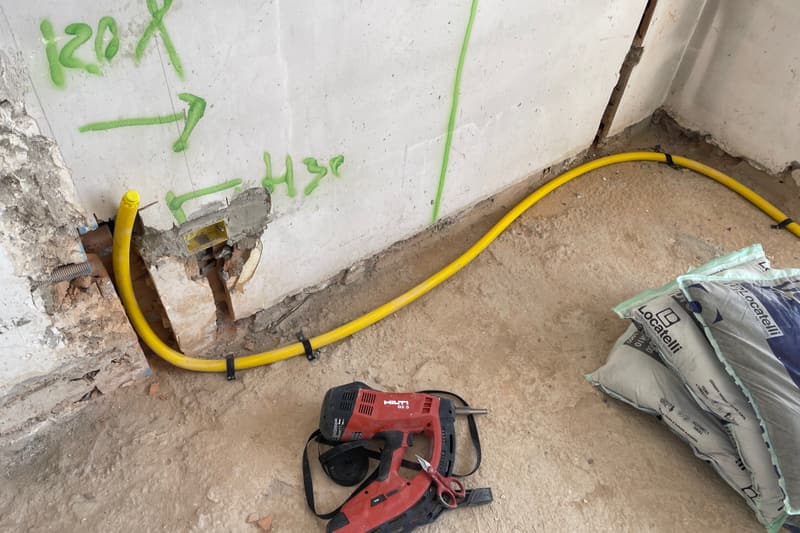
Gas under the floor, with a pipe that bends
A gas installation in a Milan flat using flexible stainless-steel pipe (CSST) laid in the screed. Why we chose it, and what the manufacturer wrote about it.

KNX and home automation
Your KNX system: what you should be handed when the job is done
At handover a KNX system should come with the ETS project, its passwords, the drawings and the declaration of conformity. What to ask for, and why it matters.
Electrical
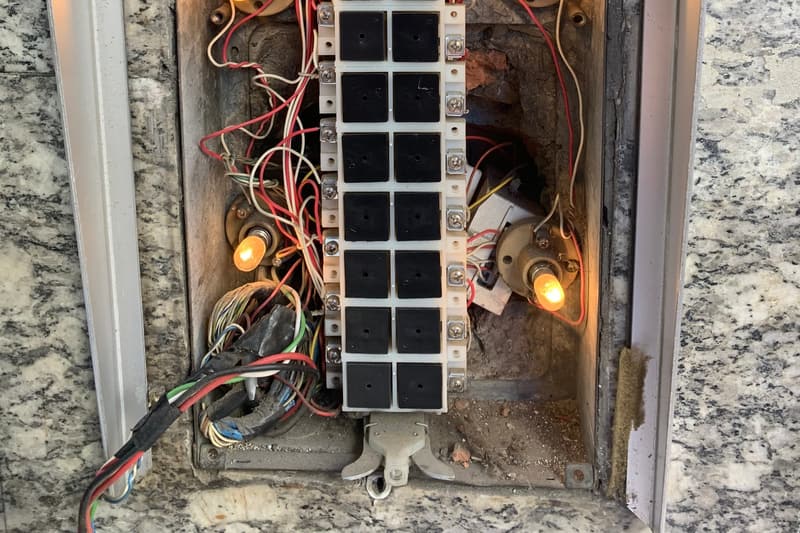
An old intercom: when we repair it and when we suggest replacing it
A faulty analogue intercom can often be repaired with the right part. What we check on a site visit, spares for Urmet, Elvox, Bitron and MM, and how to decide.


What happens when you get in touch
I’m Daniele Lantieri, managing partner and technical lead at LantierImpianti. Here’s what happens after you call or send a message.
I speak fluent English. From the first call to the end of the job, we handle everything in English: site visit, quote, works, and explaining every document you receive.
You’ll speak to me
I answer the phone myself. If I’m on site, I’ll call you back as soon as I can: before the evening or the next morning.
Tell me what’s going on, in your own words
You don’t need the technical terms — that’s our job. Just tell me what you can see or what isn’t working. A photo helps if you have one.
I tell you what I’d do
For a small job, we agree a day. If you need a quote, I come and take a look, whatever the size of the job, and send it to you in writing. The site visit for a quote is free, whatever the job.
You decide, in your own time
Calling or writing commits you to nothing. Take the time you need, and feel free to get other opinions.